
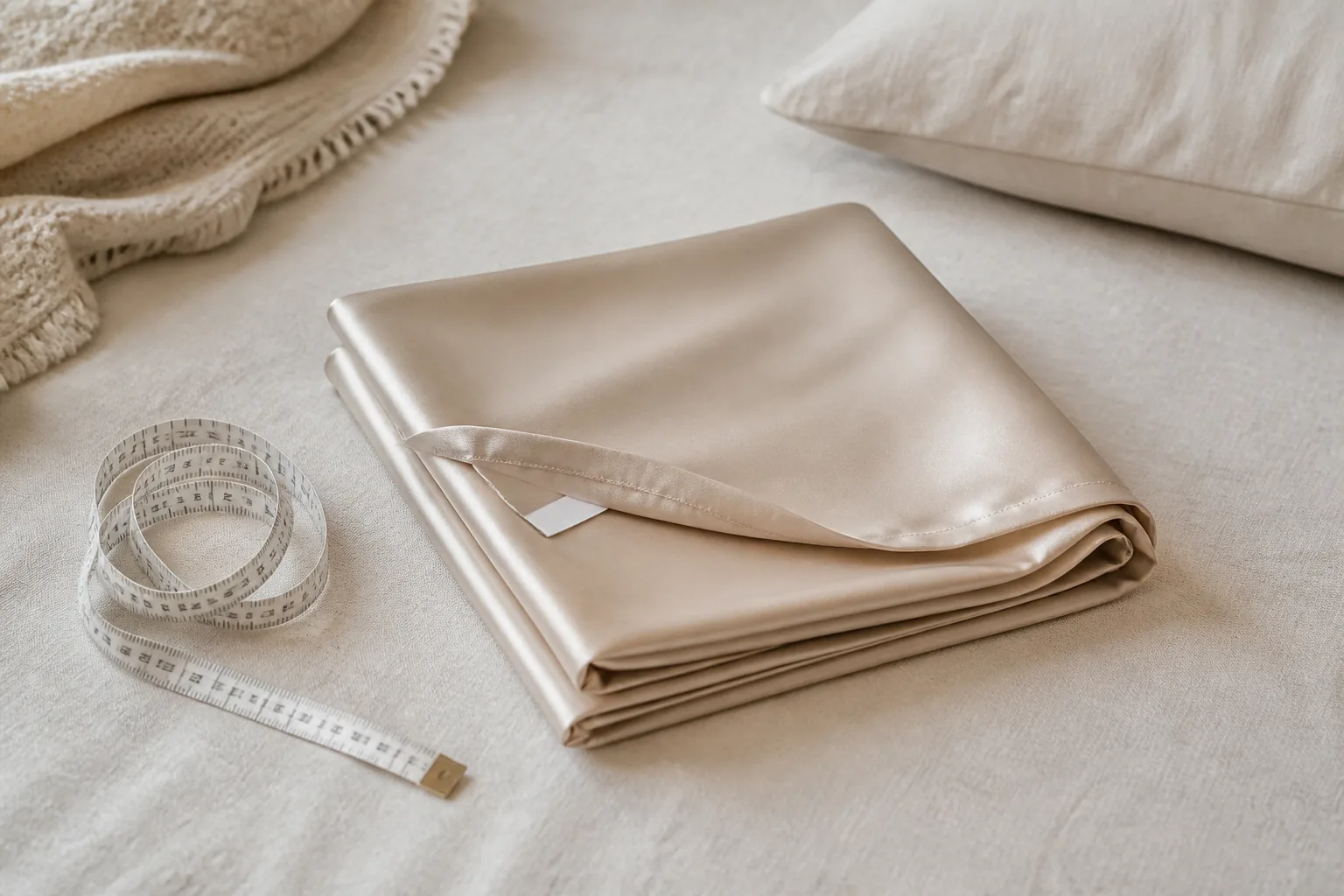
The short answer: compare a silk pillowcase by its stated fibre composition, dimensions, opening and closure, product-specific care instructions, colour information, and return conditions. Treat “silk,” “mulberry,” and a smooth appearance as product facts to verify—not as guarantees about hair, skin, temperature, durability, or sleep.
A useful pillowcase listing should help you answer two separate questions: what is the textile made from, and will the finished case work with your pillow and care routine? Marketing photographs and broad beauty claims cannot answer either question by themselves. Start with the label and measurable specifications, then identify anything the seller has not confirmed.
Six facts to compare before ordering
| Check | What to verify | Why it matters |
|---|---|---|
| Fibre content | The generic fibre name and stated percentage for the textile. | A specific composition is more useful than an unexplained “silky” or “luxury” description. |
| Finished size | Internal length, width, shape, and any model-specific fit guidance. | A case should close without compressing the pillow or pulling at its seams. |
| Opening | Zip, envelope, buttons, or open-end construction and its position. | The pillow must pass through the opening without forcing the core or closure. |
| Care | The supplied instructions for washing, detergent, drying, and ironing. | Generic silk advice must not override the directions for the finished product. |
| Colour | Variation name, current product images, and any colour-care warning. | Screen, camera, and room lighting can change how a shade appears. |
| Returns | Eligibility before opening hygiene-sensitive protective packaging. | Trying or washing bedding can affect whether a non-faulty return is accepted. |
Read the fibre statement literally
For products covered by United States textile labelling rules, the Federal Trade Commission says most household textile products should disclose fibre names and percentages by weight, together with country of origin and the identity of the manufacturer or responsible marketer. The FTC also explains that a product intentionally containing another fibre should not be represented as 100% of one fibre.
That makes a percentage statement a useful starting point, but it does not describe every property of the finished case. It does not by itself confirm dimensions, fabric weight, weave or construction, seam quality, zip quality, dye behaviour, care method, durability, certification, or where the silk was produced. Those facts need their own evidence. Requirements also vary by country, so a United States labelling guide is not a substitute for the rules that apply where a product is sold.
Measure the pillow, not the size name
Names such as standard, queen, contour, or memory foam do not guarantee one universal finished size. Remove loose bedding, let the pillow return to its normal shape, and record its longest length, widest width, highest supported point, contour, and closure needs. The pillow-measuring guide provides a step-by-step method.
Compare those measurements with the case maker’s current size chart. Do not add a generic allowance and assume it works for every design. A loose bedding case and a tailored replacement cover can intentionally fit differently. Warning signs of a poor fit include visible compression before use, a strained zip, distorted contours, an opening that requires sharp folding of the core, or loose fabric bunching across the sleeping surface.
Let the product care label override generic advice
Silk products can use different dyes, finishes, seams, closures, and constructions. Read the supplied label before washing or treating a mark. Confirm whether the finished case permits hand or machine washing, the stated water temperature, detergent restrictions, drying method, and ironing setting. If instructions are missing or conflict with the product page, ask customer care before cleaning.
- Do not assume “delicate” identifies a complete wash method.
- Do not use bleach, stain remover, machine heat, or an iron unless the instructions permit it.
- Separate the care of an ordinary outer pillowcase from a permanent pillow liner or foam core.
- Record the label before it fades, but retain the original label on the product.
- Allow every permitted-to-wash component to dry as directed before use or storage.
Evaluate comfort and beauty claims cautiously
A smooth textile surface may feel different from a rougher fabric, but that observation does not prove a guaranteed cosmetic or temperature outcome. Hair type, skin, humidity, room temperature, other bedding, laundering, and personal preference can all change the experience. A pillowcase should not be presented as preventing wrinkles, repairing hair, treating a skin condition, or regulating an entire sleep environment.
Look for claims that are narrow enough to verify. Fibre composition, current colours, quantity, closure, dimensions, care directions, and return terms can be checked. Phrases such as “wake transformed,” “stays cool all night,” or “eliminates frizz” require evidence that a photograph or customer anecdote cannot provide.
Applying the checklist to Ovio
The Ovio Mulberry Silk Pillowcase is currently listed as 100% mulberry silk and one pillowcase per order, with Champagne, Pearl White, and Moonlight Blue options when in stock. Its sewn-in label remains the authority for washing and drying. Ovio does not claim that the case prevents wrinkles, repairs hair, or guarantees temperature control.
The current Ovio product record does not provide a verified complete measurement set, closure specification, silk weight, weave, country of origin, or independent certification. Those details are therefore not estimated. If one is essential to your decision, contact Ovio before opening protective packaging and review the current return conditions.
Pillowcase comparison questions
Does “100% silk” tell me the pillowcase size or quality?
No. It is a fibre-content statement. Size, construction, finish, durability, closure, care, and workmanship need separate product information.
Can I rely on the colour shown on my screen?
Use it as a guide, not an exact guarantee. Displays, cameras, compression, and lighting can shift colour. Check all available variation images and the written colour name.
Should I wash a new pillowcase before checking the fit?
Check the fit information, care label, and return policy first. Washing or opening hygiene-sensitive packaging can change return eligibility. Do not force an unconfirmed case onto a pillow merely to test it.
A final evidence record
- Fibre name and percentage
- Country of origin and responsible business shown on the label
- Finished internal dimensions and pillow model
- Opening and closure type
- Wash, detergent, drying, and ironing directions
- Included quantity and selected colour
- Unanswered construction or certification questions
- Return eligibility before opening or washing
Sources and limits
- US Federal Trade Commission, Threading Your Way Through the Labeling Requirements Under the Textile and Wool Acts—official United States guidance on fibre, origin, and business identification disclosures for covered textiles.
- US Federal Trade Commission, Textile Fiber Rule—the official rule summary; requirements in another market may differ.
Editorial note: This is a product-comparison guide, not a laboratory test, care warranty, cosmetic claim, or legal opinion. The current product label, seller specifications, local law, and published return policy take priority.