
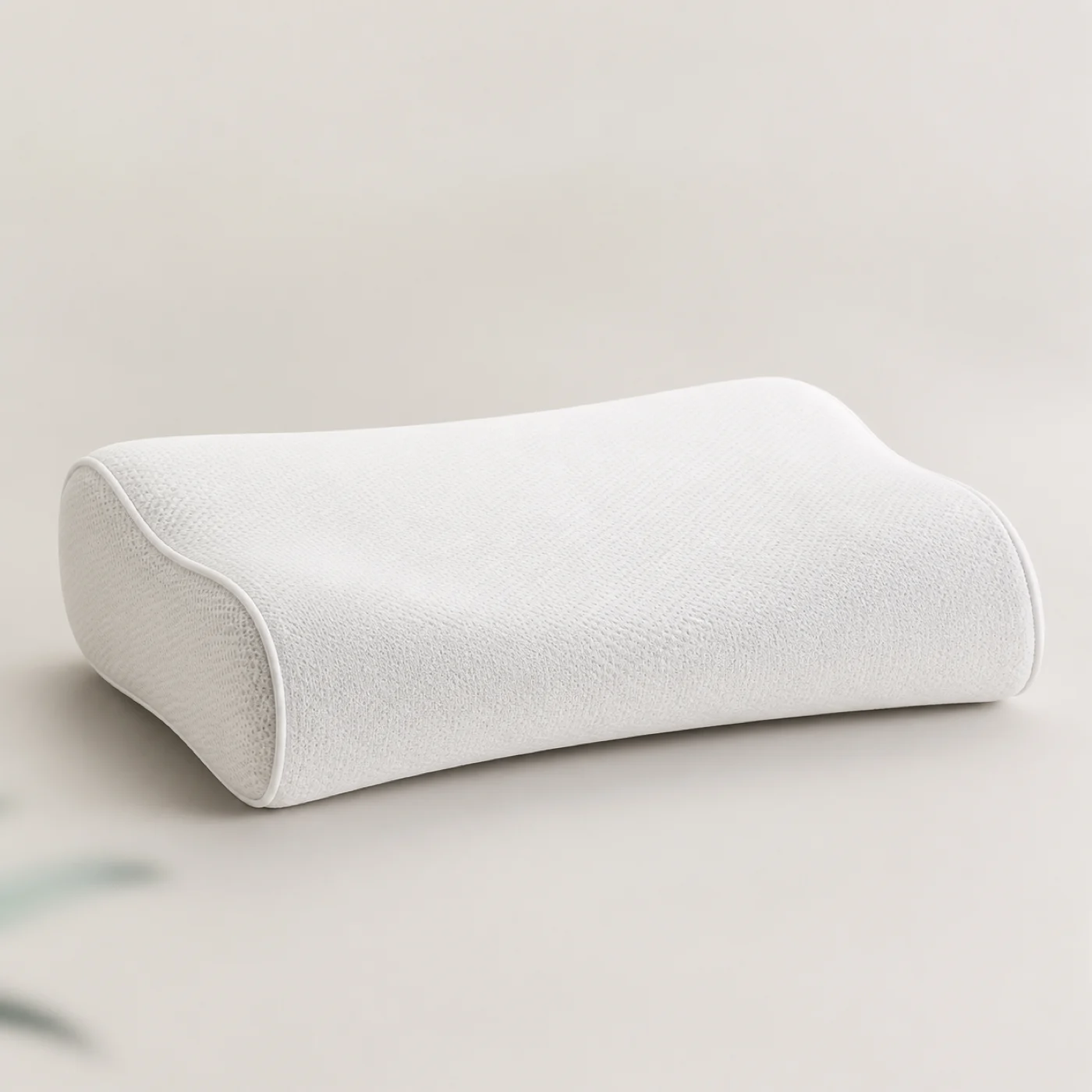
The short answer: remove loose bedding, let the pillow return to its normal shape, then measure the longest length, widest width, and highest supported point without compressing the core. Also record the pillow shape, closure position, and whether the replacement case is intended to fit closely or drape like ordinary bedding.
A pillowcase should fit the pillow you actually own, not only the size name printed on a listing. “Standard,” “queen,” “contour,” and “memory foam” can describe broad product families rather than one universal set of measurements. A few careful measurements make it easier to compare the Ovio pillowcase collection and identify questions to ask before ordering.
What should you measure?
| Measurement | How to take it | Why it matters |
|---|---|---|
| Length | Measure between the two furthest end points along the longest side. | A case that is too short can compress the pillow or leave the closure under strain. |
| Width | Measure across the widest part at a right angle to the length. | Contoured and shaped pillows may be wider through the shoulder or side zones. |
| Supported height | Measure from the surface beneath the pillow to its highest point without pressing down. | Height affects the amount of fabric needed around the core, especially with fitted zip covers. |
| Shape | Record curves, cut-outs, raised edges, centre cradles, and inserts. | A rectangular measurement alone may not show where fabric will pull or bunch. |
| Opening | Note whether the current case uses a zip, envelope, buttons, or an open end. | The opening must be large enough to insert the pillow without forcing the core or closure. |
A six-step measuring method
- Read the product label first. Use the manufacturer’s stated dimensions when they are available and current. Your measurement is a practical cross-check, not a replacement for verified specifications.
- Remove only loose bedding. Take off an ordinary outer pillowcase or protector. Do not remove a permanent liner or open the foam core.
- Let the pillow settle. Place it on a flat surface and allow foam or grid material to return to its normal unloaded shape.
- Use a flexible tape without pulling tight. Keep the tape straight for length and width. Do not wrap it around the curve unless the case maker specifically requests circumference.
- Measure the highest supported point. For a contour pillow, record both edge heights if they differ and note which side is tallest.
- Write down the result and unit. Record centimetres or inches clearly, along with the pillow name, shape, and date measured.
How much extra room should a pillowcase have?
There is no universal allowance because case designs serve different purposes. A loose bedding pillowcase usually needs enough room to slide on easily and close without squeezing the pillow. A tailored removable cover may be intentionally close-fitting so its seams, contour, and airflow panels stay in place. Follow the replacement-case size chart rather than adding an arbitrary number to every measurement.
A case is probably too small if the pillow is visibly compressed before anyone lies on it, the zip or seam is under constant tension, the contour is distorted, or the opening cannot close without force. A case may be too large if excess fabric folds under the face, shifts across a contour, or bunches around a raised edge.
Measuring contoured, grid, and memory-foam pillows
Shaped pillows need more context than a conventional rectangular pillow. For a contour, measure the highest and lowest edge as well as the centre. For a shoulder cut-out, record the maximum overall length and width instead of measuring only through the narrowest point. For an open grid, avoid pulling the tape into the cells or compressing the structure.
Do not sharply fold or roll a foam pillow simply to make it fit a smaller opening. If a close-fitting replacement cover is designed for a specific model, confirm the exact model and generation because a visually similar contour can still use different dimensions or zip placement.
Applying the method to Ovio pillows
The OrthoCloud Pillow is listed at approximately 60 × 30 × 11 cm. Use those figures as the starting point, then compare the case opening, contour, and closure. The ContourNest Pillow and CloudGrid Pillow do not currently have a complete Ovio-verified length-and-width set, so Ovio intentionally does not estimate a compatible case size for them.
If exact fit is essential, send customer care the product name, order number if available, and your measurements before purchasing a replacement. Do not rely on a product photograph as a scale reference.
Check material, care, and returns too
Fit is only one part of the decision. Confirm the fibre content, closure, wash and drying instructions, colour, included quantity, and whether the case is sold for bedding use or as a model-specific removable cover. The Ovio Mulberry Silk Pillowcase is listed as 100% mulberry silk; its sewn-in care label remains the authority for washing and drying.
Review the return policy before opening hygiene-sensitive packaging. Measuring first reduces avoidable fit problems, but it does not override a product-specific return restriction or guarantee that a different brand’s case will follow the same sizing convention.
Pillowcase-fit questions
Should I measure the pillow with the current case on?
Remove loose bedding and protectors so you measure the pillow or its permanent fitted liner. Leave any non-removable inner cover in place and do not expose or damage the core.
Can I use a standard pillowcase on a contour pillow?
Possibly, if its internal dimensions and opening accommodate the pillow without compressing or distorting it. A model-specific fitted cover may follow the contour more closely than loose bedding.
Does a tighter case make a pillow more supportive?
Do not use an undersized case to change pillow performance. Compression can alter the intended shape and create stress at seams or zips. Choose fit from verified dimensions and use the pillow as directed.
A final measurement record
- Product or model name
- Length and width, with units
- Highest and lowest profile points
- Contour, cut-out, or raised-edge notes
- Current closure type and position
- Replacement-case internal dimensions
- Material and care requirements
- Any unresolved fit question for customer care
Measurement note: This guide provides general product-fit information, not medical advice or a compatibility guarantee. Manufacturer specifications and the replacement product’s current size chart take priority, and unknown dimensions should be confirmed rather than estimated.