
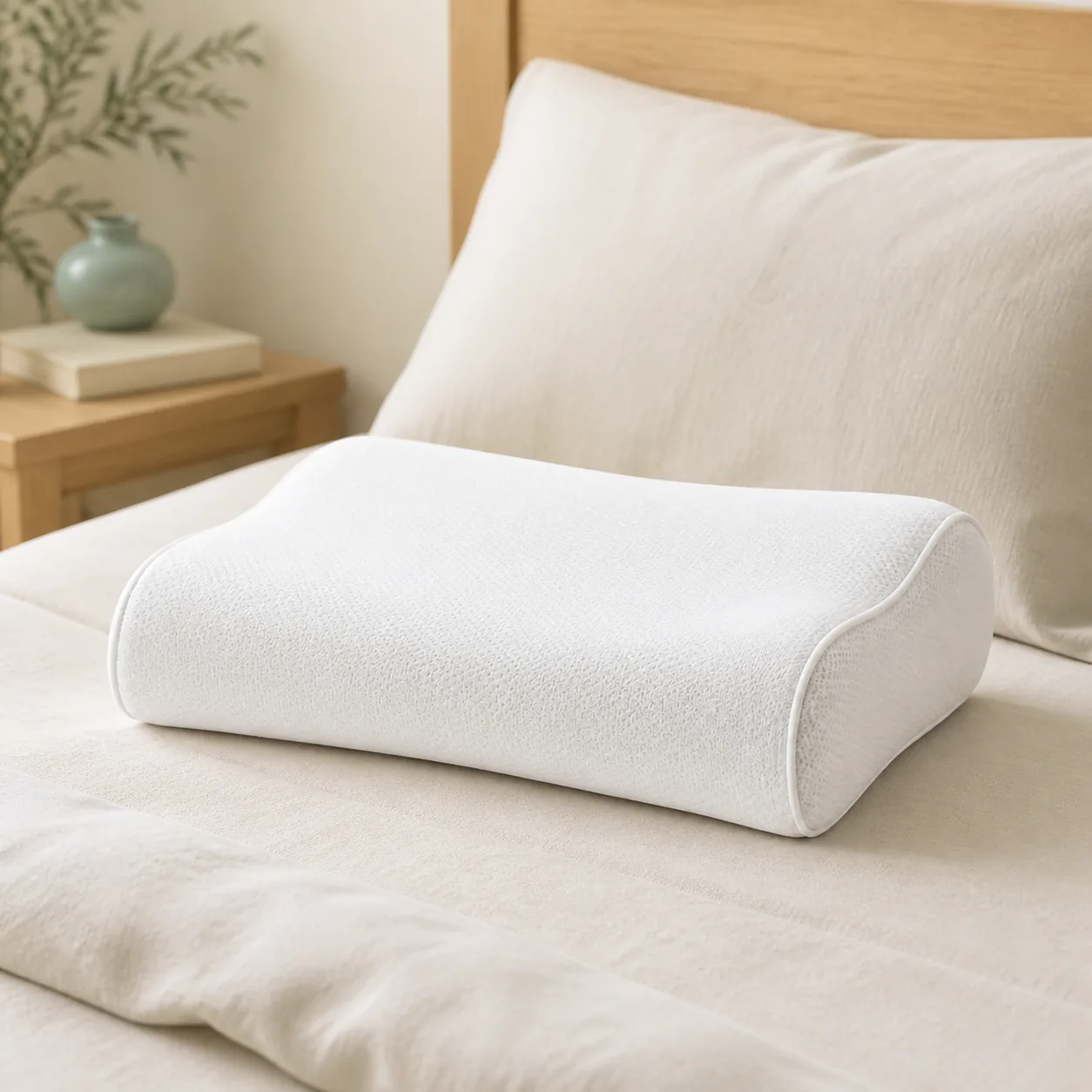
The short answer: a comfortable pillow height fills the space between your head and the mattress without forcing your head noticeably upward or letting it drop. Sleep position matters, but shoulder width, mattress softness, body shape, and personal comfort also change the fit.
There is no single pillow height that works for everyone. Laboratory research shows that changing pillow height changes pressure and head-neck alignment, while studies of side sleepers also point to individual body dimensions as relevant factors. That makes height a comparison tool—not a diagnosis or a universal prescription.
What does pillow height mean?
Pillow height, often called loft, is the distance between the mattress and the upper surface of the pillow when it is supporting your head. The listed height is useful, but it is not the whole answer: a soft pillow can compress more than a firmer pillow with the same measurement.
| Factor | Why it changes the fit | What to compare |
|---|---|---|
| Sleep position | Side, back, and front positions create different spaces between the head and mattress. | Which position you use most often—not just how you fall asleep. |
| Shoulder width | Broader shoulders can create a larger gap in side sleeping. | Your head position after the pillow has compressed. |
| Mattress feel | Shoulders sink farther into a softer mattress, which can reduce the space a pillow needs to fill. | The pillow on your own mattress, not on a shop shelf. |
| Core firmness | Different foams, fibres, and grid structures compress differently. | Supported height after several minutes of use. |
| Personal preference | Comfort remains subjective even when measurements look similar. | Ease of settling, pressure, warmth, and morning comfort. |
A practical starting point by sleep position
Side sleeping
Side sleepers often need enough supported height to fill the space created by the shoulder. A firmer mattress may leave more of the shoulder above the surface; a softer mattress may let it sink farther. Start by checking whether your head appears to tilt toward the mattress or away from it after the pillow settles.
Back sleeping
Back sleepers commonly prefer a lower or contoured profile that supports the space beneath the neck without pushing the head sharply forward. A pillow with two contour heights, such as the CloudGrid Pillow, gives you two starting points to compare.
Front sleeping
Front sleeping already involves turning the head to one side, so a tall pillow can feel excessive for some people. A lower, softer option—or no head pillow—may feel more natural, but persistent discomfort should be discussed with a qualified health professional.
How to check pillow height at home
- Use your normal mattress and bedding. The same pillow can sit differently on another surface.
- Settle into your usual position. Give the material several minutes to compress and respond.
- Notice obvious tilt. Ask whether your head feels pushed up, dropped down, or comfortably supported.
- Check pressure and temperature. Height is only one part of comfort; surface pressure and heat can matter just as much.
- Compare for several nights. One brief trial may not reflect a full night or your normal position changes.
- Record the result. Note the contour used, your main position, and how you felt on waking so the comparison is less dependent on memory.
What does the research actually show?
A small experimental study of ten healthy adults found that increasing pillow height changed cranio-cervical pressure and cervical alignment. The authors also noted that universal evidence-based selection guidelines were not available. A separate randomized laboratory study found that different pillow materials and shapes changed side-lying spinal slopes, but it did not establish one ideal pillow for every sleeper.
The useful conclusion is modest: height and construction can change how a pillow supports you, while the “best” result remains individual. Treat exact centimetre recommendations as a starting point unless they come from a clinician who has assessed your circumstances.
When should you try a different height?
- Your head feels obviously pushed forward or tilted sideways.
- You keep folding, stacking, or removing pillows to settle.
- The pillow compresses so far that support changes through the night.
- You feel concentrated pressure at the head, neck, shoulder, or ear.
- Your current pillow no longer returns to its intended shape.
These are comparison signals, not medical tests. New, severe, or persistent pain, numbness, weakness, headaches, or sleep problems deserve qualified medical advice rather than another product claim.
Pillow-height questions
Is a higher pillow always better for side sleepers?
No. Shoulder width, mattress sink, pillow compression, and personal preference all matter. The goal is supported comfort, not the highest available measurement.
Can a pillow fix neck pain?
No pillow should be presented as a guaranteed treatment. A different height may change comfort and positioning, but persistent or worsening pain needs professional assessment.
Sources and evidence limits
- Ren et al., Effect of pillow height on the biomechanics of the head-neck complex (PeerJ, 2016)—a small pressure and modelling study in healthy adults.
- Gordon et al., Does pillow type alter cervico-thoracic spinal posture when side lying? (Chiropractic & Manual Therapies, 2011)—a controlled laboratory comparison, not a long-term treatment study.
- Lei et al., The individualized optimal pillow height and neck support design for side sleepers (Medical & Biological Engineering & Computing, 2024)—a small experimental study supporting individualized comparison.
Editorial note: Ovio provides general product-comparison information, not medical advice. The studies above are limited by small samples and controlled settings, and they do not prove that a particular Ovio product treats pain or improves sleep.